10 Commandments of Squash:

    Written by Brent Johner


In 1974, eight-time British Open Champion Geoff Hunt laid down his Ten Commandments of Squash. In 2001, Hunt Richardson updated and expanded them as they appear below.

More than a generation after they first appeared, racquets, balls and rules have all changed. But the Ten Commandments of Squash remain essentially intact. Live by these rules on the squash court and your game will improve at all levels.

Squash 10 Commandments


1. From behind your opponent, use a full swing to hit the ball to good length. Aim high, well above the service line. This keeps your opponent behind you.

2. From behind your opponent, use a full swing to aim into the back corners. This makes your opponent run more and reduces their swing area. Also gives you more time to recover to a central position.

3. From in front of your opponent, hit low and softly into the nick. This makes your opponent stretch, and takes away the time they have to hit the ball. It can become a winning shot. Hit down the back of the ball with an open racquet face. Caress it. Follow through so the ball reaches the front wall. Look for loose response shots from your opponent that you can put away.

4. When you and your opponent are in the frontcourt at the same time, hit hard, one to two feet above the tin. This usually results in a winning shot. Avoid the tin!

5. Keep your shots close to the sidewalls. This makes your opponent run farther. It takes your opponent off the Tee, and makes it more difficult to hit the ball well. The closer, the better.

6. After hitting your shot, recover immediately to the Tee, or best central position. The sooner you recover, the more relaxed you will be, and the less energy will you spend overall.

7. Always watch the ball. All the information is there. You can better read your opponent’s swing and anticipate where the ball will go. During rallies, keep your eyes on the ball, no matter where it is. Your reaction time will improve.

8. Make your opponent run. Hit the ball as far from your opponent as possible. If you cannot do that, then hit the best possible shot. Avoid daring shots unless forced to hit them.

9. Volley whenever possible. It will make your opponent rush.

10. Vary the pace and height of your shots. Changing the rhythm of the game can be unsettling to your opponent. When out of position in the frontcourt, lob to buy time to recover. Careful with the out lines!


High PAR scores 

  Nov  2nd week  in a fun match

     Gary Delavigne vs Ted Zalewski    Gary 25  Ted 23


  week 2

     Ted Zalewski vs Kerry Margetts    Ted 22 - Kerry 20


  week 26

    Gary Delavign vs Andy Spettigue     Gary 30 Andy 28


Archived Crazy,Interesting or Simply Goofy Squash Fact of the Week: 


Sept 30 2009 The impact of a squash ball at 150 KPH is equal to the same energy as a .22 bullet. Ouch!!!!

Oct 7 2009 Squash provides an excellent cardiovacular workout. In one hour of squash, a player may expend approximately 700 - 1000 calorie ( 3,000 to 4000kJ ) which is significantly more than most other sports and over 70% more than either general tennis or racquetball. 

Oct 14 2009 Squash and the Titanic: The squash court was a convenient place to monitor the rise of the water ( it was below the bridge ) and this was done presumably from the viewing gallery. This periodic viewing is featured in the ship's log.

 It cost 50 cents a session and there was even a "Racquet Professional" aboard. A Mr. F Wright. Colonel Archibald Gracie, who survived, writes in his book that he told Wright shortly after the collision " perhaps we had better cancel our match for tomorrow morning." The court was 30ft long and 20ft wide as against 32 and 21ft of a now-a-days court. This was due to the structural layout of the ship. Again, due to the structure, the court height could not have been more than 15ft 8 inches as against the current 18ft 6 inches. Lobs would have had to be low ones. 

Oct 21 2009 The Spin of the Racquet by Will Carlin December 2008 Remember that? For those of you who don't, this was the most common method of deciding server for many years. One player would spin a racquet and the other would call "Rough" or "Smooth" which referred to fine stringing (known as the "trimming" or "trim") at the head (and sometimes the bottom) of the racquet face; this extra string - that looked like heavy thread - went from one side of the head to the other but instead of going over and under the vertical mainstring, it went all the way around each mainstring. On one face of the racquet (the "smooth" side), therefore, your finger could trace the trimming in a continuous line, gliding over the mainstrings; on the "rough" side, your finger would stop at every mainstring as the trim looped around it.

The trim was an artifact. When tennis first began, racquets originally all were strung with this "around the mainstring" pattern, so that one entire face was "rough" or "smooth." Once the cross-strings were weaved over and under the mainstrings as they are today, the trim became a decorative nod to the past. These days, the trim has disappeared, and the racquet tosser most commonly asks "Up or down?" Sometimes, if the racquet is a Wilson, the call becomes "M or W?" If a Prince, it might be "P or D?"

http://www.squashmagazine.com/vcm/squashmagazine/COLUMNS/spin_of_the_racquet.html


Oct 28 2009 Quote from Squash A History of the Game by James Zug:

 "The ball of the schoolboys originally swatted was a globe of vulcanized India rubber pierced with a hole. At the turn of the 20th century, it became a gutta-percha ball, then the Hewitt, the black Seamless, the Cragin green diamond, the revolutionary blue Merco 70+, the Slazenger fushia ball, and now the black Dunlop Revelation Pro XX Yellow Dot. The ball has always been small and quick, an effulgent moonrock flashing and floating through the white space of the court. It cruises like a nuclear pinball. It ricochets like bees shaken in a jar. It darts like a scared serpent. And then it dies upon command. Like a faddish board game from the 1970's, squash is the Othello of games. It takes a minute to learn but a lifetime to master."

 Nov 4 2009 

  In 2005 Squash Ontario    http://www.squashontario.com/hall_fame/officialopening.asp  opened the Hall of Fame. The first induction ceremony was held on June 2 2005 to pay respect to those who made great contributions to the game of squash in Ontario. The Hall of Fame is located at the White Oaks Resort in Niagra on the Lake Ontario http://www.whiteoaksresort.com/ There will be inductions every odd numbered year.

  Nov 11 2009 

  Gary Waite

Gary Waite hails from Sarnia Ontario.  After having been exposed to squash by his parents Lewis and Janet at the age of 12, Gary came under the care of Jack Clift and his weekend junior squash program and became part of a burdgeoning junior squash movement in the area inundating courts at Pinsonneault's and the Riding Club for years to come. Through the tireless efforts of Jack, Lew, Janet and so many other parents at the time Sarnia could lay claim to a National Champion in every age group.  Gary, in particular, garnered more titles than any other junior squash player in the history of Canadian squash.  He would continue this trend into the professional ranks to become one of the most decorated professional squash players in the history of the game worldwide. In 1993, while attending Harvard University, Gary could lay claim to being the #1 hardball singles player, #2 hardball doubles player and #12 softball singles player in the World... a feat in combined rankings not achieved by any player in the history of either game.

Gary put on hold his professional squash playing aspirations a year ago with the impending birth of his fifth child with his beautiful wife Nathalie. His current commitment to the game is in the development of an infrastructure for the game of hardball doubles in North America.  The project is a US Squash endorsed effort named The Elmaleh Project after its benefactor Mr Victor Elmaleh.


 Nov 18 2009


World Squash Statistics

There are more than 15 million people playing squash on over 47,000 courts in the world, spanning over 150 countries.

Participation by Country

England 8,666 courts
Germany 6,000 courts
Australia 3,578 courts
Egypt 3,700 courts
Malaysia 1,500 courts
United States 3,315 courts
Canada 1,810 courts **


Squash in Canada


In Canada, squash is played by more than a quarter of a million people over the age of 15. This is more people than cycling, and more participants than gymnastics, track and field, and figure skating, all combined. Players compete at over 425 clubs (private/public) in Canada with the greatest concentration in Ontario.


Nov 18 2009

One Hundred and Thirty Years of Squash

For over 1000 years man has invented and enjoyed a variety of games played by hitting a ball with either a closed fist - as in "fives" or "bunch of fingers" - or with some form of bat or racket. Around the year 1148 the French played "le Paume", meaning "the palm of the hand", which developed into Jeu de Paume, Real Tennis, Royal Tennis or, if you play the sport, simply Tennis. At sometime in the early 19th century this obsession with rackets and balls spawned another variety of the sport in the unlikely birthplace of the Fleet Prison in London. The prisoners in "The Fleet", mainly debtors, took their exercise by hitting a ball against walls, of which there were many, with rackets and so started the game of "Rackets". Rackets progressed, by some strange route, to Harrow and other select English schools about 1820 and it was from this source that our own sport of Squash, or Squash Rackets, developed.

Squash was invented in Harrow school around 1830, when the pupils discovered that a punctured Rackets ball, which "squashed" on impact with the wall, produced a game with a greater variety of shots and required much more effort on the part of the players, who could not simply wait for the ball to bounce back to them as with Rackets. The variant proved popular and in 1864 the first four Squash courts were constructed at the school and Squash was officially founded as a sport in its own right.


Dec. 2 2009: 

  Squash at the Canada Winter Games 2011Squash is one of the 21 sports included at the games, and it will be held at the newly renovated courts at Saint Mary's Tower from Saturday February 12 - Friday February 18, 2011.  The court renovations were made possible by major funding from the Canada Games Council as a legacy to Squash Nova Scotia from hosting the Games.  In addition to the court renovations, there will be an all glass court on hand during the event for the first time in Nova Scotia history.


Dec 9 2009: 

    No issue published


Dec 16 2009:  
Longest Winning Streak

   Jahangir Khan won 555 match's was the longest streak in squash history


Jan 6 2010: Dots on the Balls

    Most of us know that there are different coloured dots on the squash balls and what they represent. That is they are the speed indicator recognizing the following:

  • Double Yellow - Extra Super slow (very low bounce)
  • Yellow - Super slow (low bounce)
  • Green or White - slow (average bounce)
  • Red - Medium (high bounce)
  • Blue - Fast (very high bounce)

      But did you know there is a high altitude " orange dot " ball used in places like Mexico City, Calgary, Denver, and Johannesburg. Other balls available are: 

  • Dunlop 'Max Blue' (aimed at beginners) which is 12 percent larger and has 40 percent longer 'hang time' than a 'double yellow' dot ball and has 'instant bounce'
  • Dunlop 'Max Progress' (red) (for players wishing to improve their technique) which is 6 percent larger with a 20 percent longer hang-time than a 'double yellow' dot ball and has instant bounce

   Jan 13 2010:  Squash Strings facts


  • Squash strings are made of natural gut, nylon or aramid fibre.
  • Strings are always losing tension because the inner molecules are continually moving apart and this “Creep” continues until it breaks.
  • Strings break for two reasons – when they rub against each other and wear away until one of them gets too thin and breaks or when the string cannot stretch enough on ball impact, usually near the edge of the racket.  

  • Strings work by absorbing the incoming ball impact and then returning it with as much velocity as possible. The more elastic the string, the more speed on the return journey.

Thinner strings will be more elastic, will break quicker, thicker strings will be generally more durable but less able to return the ball fast.


  Jan 20 2010:  Longest matches:

,Nov 2008 in Baltimore, Shawn Delierre and Shahier Razik showed that intense focus can turn two evenly matched players into marathon duellers, in the longest match ever recorded in PAR scoring Delierre beat Razik in an historic 9-11, 8-11, 11-7, 13-11, 11-5 victory after two hours and 30 minutes! The longest match ever was two hours and 46 minutes between the legendary Jahangir Khan and the great Egyptian Gamal Awad, using the nine point system.


Jan 27 2010: Racquets:

,

'Standard' squash racquets are governed by the rules of the game. Traditionally they were made of laminated timber (typically Ash), with a small strung area using natural 'gut' strings. After a rule change in the mid-1980s, they are now almost always made of composite materials or metals (graphite, Kevlar, titanium, and/or boron) with synthetic strings. Modern racquets are 70 cm long, with a maximum strung area of 500 square centimetres (approximately 75 square inches) and a weight between 110 and 200 grams (4–7 ounces).


 Feb 10 2010:


The oldest known squash trophy in America; 1896, won by Richard Sears; Photo by Ben Collier

Feb 17 2010: 


courtgames01toom1.pdf courtgames01toom1.pdf
Size : 7561 Kb
Type : pdf


Feb 24 2010: 

A Book about Squash: 


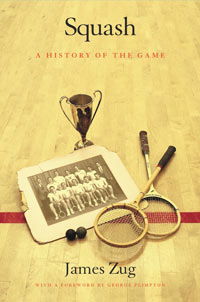
Published by Scribner in September 2003, Squash has a foreword written by the late George Plimpton. The first history of the game in the United States since 1930, Squash incorporates every aspect of this increasingly popular sport. Invented by English schoolboys in the 1850s, squash first came to the United States in 1884 when St. Paul's School in New Hampshire built four open-air courts. The game took hold in Philadelphia, where players founded the U.S. Squash Racquets Association in 1904, and became one of the primary pastimes of the nation's elite. Squash launched a U.S. Open in 1954, but its present boom started in the 1970s when commercial squash clubs took the sport public. In the 1980s a pro tour sprung up to offer tournaments on portable glass courts in dramatic locales such as the Winter Garden at the World Trade Center. Today the sport is seen on the Tennis Channel and experienced live at exciting pro tournaments in Grand Central Station in New York and Boston's Symphony Hall.

James Zug is a senior writer at Squash Magazine. He is the official historian of US Squash and writes a monthly column, The Direct, which can be found at the US Squash website. He is the chair of the United States Squash Hall of Fame and a founder of DC Squash Academy, an after-school youth enrichment program.


Mar 3 2010: 

Squash in popular culture from Wikipedia:

The 1980 novel Boast by Miles Donald revolves around the game of squash.

In David Lean's Lawrence of Arabia a staff officer tells Lawrence about the new squash court at GHQ in Cairo when Lawrence asks what has been happening at base while he has been in the desert leading the Arab revolt.

In the TV sitcom "Frasier", squash was a game Frasier and his brother Niles would play.

In the movie Wall Street, Gordon Gekko (Michael Douglas) and Bud Fox (Charlie Sheen) play a game of squash.

In the television series "Friday Night Lights", Coach Eric Taylor and "Smash" Williams play a game of squash, which Smash describes as the "whitest sport ever".

In the television series Green Wing, Mac and Guy Secretan play a game of squash in the episode "Emergency". Guy is equipped with appropriate squash gear, while Mac is left playing in his surgical scrubs with a ping-pong paddle.

In the novel Digital Fortress by Dan Brown David Becker's hobby is playing squash.

In the film Shallow Grave Shallow Grave the main characters play each other at squash.

In the 2005 novel Saturday by Ian McEwan, Henry Perowne plays a regular weekly squash game.

In the 1981 movie Outland, Marshal William T. O'Niel (played by Sean Connery) plays squash alone and against his female ally, Doctor Lazarus (Frances Sternhagen).

In the John Irving novel "A Widow for One Year" the character Ruth Cole plays squash and defends herself against an assault on the squash court.

In 2009, the first and only[citation needed] squash 3D video game, Touch Squash, was launched on the iPhone App Store for iPhone and iPod touch.

Squash is a minigame from Super Monkey Ball: Banana Blitz, released as a launch title on the Wii in December 2006.

A simplified version of squash appears as a bonus minigame in Tiny Toon Adventures: Buster Busts Loose!.

British comedy duo The Two Ronnies did a sketch in 1983 where Ronnie Corbett plays an experienced squash player who gets thrashed by newcomer Ronnie Barker.


Mar 10 2010: 

Ubisoft has just announced Racquet Sports, an all new sports game for the Wii  and will give a whole new meaning to the word interactivity.

Racquet Sports

Racquet Sports is a multisport game that includes tennis, ping pong, badminton, squash and beach tennis, putting players in 40 rich graphical environments in worldwide locations such as an underwater reef, a Moroccan palace, a New York loft, and a fan-filled stadium.

http://racquetsportsgame.us.ubi.com/


Mar 24 2010:  

And for only $795.00 us you can buy the book titled   The 2007-2012 World Outlook for Squash BallsThis study covers the world outlook for squash balls across more than 200 countries. For each year reported, estimates are given for the latent demand, or potential industry earnings (P.I.E.), for the country in question (in millions of U.S. dollars), the percent share the country is of the region and of the globe. These comparative benchmarks allow the reader to quickly gauge a country vis-à-vis others 


Mar 31 2010:  

US Pro Squash Tour Revolutionizes Game Play

Players Are Now Limited to Five Lets Per Match


Each player will begin a match with 5 lets at his disposal. A player requesting a let will still say “Let, please” to the referee. And the referee will continue to have three options: “Yes, let”, “No let” or “Stroke to Player A”. If the call is “Yes, let”, the referee will then follow with, “Player A has used his first let. He now has 4 remaining. If a player requests a let and the referee responds with a “no let” or “stroke” call, the player will still retain his 5 lets. Once the player’s 5 lets have been exhausted, the referee will only be able to award a “no let” or a “stroke” call.


To read more go to 

              http://www.prosquashtour.org/


April 14 2010

                         "Drive for show, drop for dough."  


Quiz of the Week: 


Nov 4 2009  After the end of a game both players leave the court. When the player who lost the game returns to the court he finds that the ball is broken and informs the Referee. What should the Referee do?
a) Order the players to replay the last point of the previous game
b) Order the new game to begin.
c) Ask the Tournament Referee for a ruling.


Answer  Once you leave the court you are saying in effect: "I accept the result of that game." There is then no further appeal. If you wish to appeal, don't leave the court (Rule 14.4). 

Nov 11 2009 

  Player A serves the ball and you (the ref.) think that it might have touched the line. At the end of the rally which the server won the opponent asks for a let on the service. What should the ref. do ?


  Answer  As referee you were correct not to stop the rally if you were unsure of the service. You should now allow a LET as you were in doubt. The winning or losing of the rally makes no difference to this decision.

Nov 18 2009

  A player breaks her racket during a rally and asks for a let. What is your decision as the ref and how long has the player to replace her racket?


 Answer   NO LET for the broken racket and 90 seconds for the change of equipment


Nov 25 2009 

  After throwing the ball into the air, the server becomes off balance and makes no attempt to strike the ball. Is it a fault? If not, why not?

What is the referees decision and why?


  Answer:  No it is not a fault as the player was not “ committed to the shot” He/she has made no attempt to strike the ball after it has been released

Dec 2 2009:

 Which is “Not Up” and which is “Down”

  1)   the player did not strike the ball
correctly, or the ball bounced more than once on the floor before the striker hits it, or
the ball touched the striker or anything worn or carried other than the racket, or the
server made one or more attempts to strike the ball but failed to do so

   2)      To indicate that an otherwise good service or return has struck the floor before
reaching the front wall or has struck the board or tin


  Answer:   1 is "Not Up" and 2 is "Down"


Dec 9 2009

   No issue published 


Dec 16 2009

   A player stops playing and claims that noise from outside the court has caused a distraction. What action would the refree take?


Answer  Decide if there was such a distraction If so, Yes Let. 


 Jan 6 2010 

    You are a single official acting as both Marker and Referee. After calling a ball ‘Not Up’ during a rally, the player appeals against the call. You change your mind and decide that a ‘Yes Let’ decision is more appropriate. The players opponent then appeals on the grounds that you cannot change your decision.

What is the referees action & why? 


  Answer:  As a single official you act as both Marker and Referee. Any call made by you as the Marker can be appealed against but as your role as Referee you can uphold or change any decision you have previously made as marker. No appeal is allowed against a Referee's decision


 Jan 13 2010

A player serves from the incorrect side of the court but you did not stop the serve. At the end of the rally the receiver - who lost the rally - asks for a let on the serve as it was from the wrong side

What is the referees action & why? 


Answer: As referee you should have made sure that the serve was taken fron the correct side. However, once the receiver accepts the serve then the result of the rally should stand and your decision is NO LET. The same would apply if the server had lost the rally.


 Jan 20 2010

   If a player, at the front of the court, hits the ball, which then hits the front wall and then hits him/her directly AND the opponent is lying on the floor at the back of the court and makes no attempt whatsoever to get the ball....is this a stroke? 


   Answer:  If you hit yourself with your own shot, you lose the point. The only exception is if your opponent has blocked your exit -- which is clearly not the case here.


Jan 27 2010:


  Question:
 
The serving player throws the ball into the air but does not serve instead he/she catches the ball. Is it handout?


   Answer: No. Server can re-serve


 Feb 10 2010:


    Question:When was squash first included in the Panamerican games?


     Answer:1995


Feb 17 2010: 


Question: Your Opponent is sweating too much You feel it is unsafe to continue play and ask the referee for a decision. What does the referee decide?


  Answer:

 It is the referee's job to, among other things, make sure the court is safe and playable for the players. This would include ensuring that the court floor is not so slippery that it would constitute a safety hazard. This could be caused by a number of factors.........dust, grit, grime, dirt, small pieces of paper, pieces of plastic from a racquet and so on.........and not just things that come from players, but things that derive from outside agencies, such as previous players, spectators and so on. In an extreme example, if a player vomits on court, that player must automatically default the match, since it assumed that the court has become unplayable!!!

 It would or could also include sweat, and although it is hard to imagine a player sweating so much that it becomes a hazard, you seem to have experienced just such an example.

 The remedies available to a referee are to stop play and examine the court surface to determine the playability. The referee has to decide if the amount of sweat coming from the player(s) constiutes a hazard.  With court surfaces unsanded, the sweat is supposed to be absorbed quickly enough into the wood for there to be no cause for concern.

 However, if it does seem to be a major issue for more than one game, the referee should suggest that the player change shirts frequently (between games), and wear a headband or bandana to minimize dripping.

 There is no provision for the player to leave a towel on court (as in tennis), hang it over the back wall, or leave it outside the court and keep stopping play to go out and wipe his/her head/arms/brow etc (remember, the referee has to ensure continuous play), but nothing in the rules prevents a player from putting a cloth of some sort in a shorts or pants pocket and pulling it out from time to time (however, if it drops, the players loses the rally, remember!!!!).

 If these options don't work, the ultimate solution has to be for the player causing the court to become unplayable to forfeit at least a game or even the match, but this would have to be extreme, and you as the referee would need to be absolutely certain that it was JUST caused by the one player ALONE (presumably the other player would be sweating as well, unless they are reptilian in nature).

 As I said earlier, it's hard to imagine, I've never seen it at the pro or very high amatuer level of squash, where, with all due respect, the rallies last generally much longer, and the generally accepted solution (mainly when one player falls) is to use a towel (on the floor!!!!) and change shirts in between games.

 I hope this helps somewhat........you can't tell a player not to sweat, but you CAN tell him/her that he/she must take measures to prevent the court from becoming unplayable.


Happy Squashing

 Simon Warder

Certified Squash Ontario Official

Provincial Examiner

Feb 24 2010:  

Question:

 What is a trickle boast?

  1  The ball is hit high to the side wall near the front wall so that it travels cross court and falls in the opposite back corner.


  2   A 'short' boast where the ball is hit to the side wall at the front of the court (often disguised as a drive or drop shot).


  3  A more difficult shot which is hit from the front of the court when the ball is very close to the side wall. Has the same effect as the trickle boast but is more deceptive because of its difficulty.


Answer:   2   A 'short' boast where the ball is hit to the side wall at the front of the court (often disguised as a drive or drop shot). 


  1 Is a  Skid Boast: The ball is hit high to the side wall near the front wall so that it travels cross court and falls in the opposite back corner.


   3 Is a Squeeze Boast: A more difficult shot which is hit from the front of the court when the ball is very close to the side wall. Has the same effect as the trickle boast but is more deceptive because of its difficulty.

Mar 3  2010:   


Question:

What is the longest wining streak in squash: Pick either 1,2,3 or 4 

  1 Gary Waite 321 consecutive wins

  2 Jansher Khan  250 consecutive wins

  3 Peter Nichol   250 consecutive wins

  4 Jahangir Khan 555 consecutive wins


Answer:  

4 Jahangir Khan 555 consecutive wins. The others are made up numbers.

Five-year unbeaten run

In 1981, when he was 17, Jahangir became the youngest winner of the World Open, beating Australia's Geoff Hunt (the game's dominant player in the late-1970s) in the final. That tournament marked the start of an unbeaten run which lasted for five years and over 500 matches. The hallmark of his play was his incredible fitness and stamina, which Rehmat Khan helped him build-up through a punishing training and conditioning regime. Jahangir was quite simply the fittest player in the game, and would wear his opponents down through long rallies played at a furious pace.

In 1982, Jahangir astonished everyone by winning the International Squash Players Association Championship without losing a single point.

The unbeaten run finally came to end in the final of the World Open in 1986 in Toulouse, France, when Jahangir lost to New Zealand's Ross Norman. Norman had been in pursuit of Jahangir's unbeaten streak, being beaten time and time again. "One day Jahangir will be slightly off his game and I will get him," he vowed for five years.

Speaking about his unbeaten streak, Jahangir said: "It wasn't my plan to create such a record. All I did was put in the effort to win every match I played and it went on for weeks, months and years until my defeat to Ross Norman in Toulouse in 1986."

"The pressure began to mount as I kept winning every time and people were anxious to see if I could be beaten. In that World Open final, Ross got me. It was exactly five years and eight months. I was unbeaten for another nine months after that defeat."


Mar 10 2010:    

Question: 

If a dropped object remains unnoticed until the end of the rally, the result of the rally shall be:

  1)  Let

  2) Stroke

  3) The result of the rally shall stand.


Answer:  

If a dropped object remains unnoticed until the end of the rally, the result of the rally shall be: 

  3) The result of the rally shall stand.


7.         CONTINUITY OF PLAY 7.7.6    If a dropped object remains unnoticed until the end of the rally, the result of the rally shall stand.  


Mar 24 2010: 

Question. A player strikes at the ball and misses, and on his second attempt would have hit his opponent with the ball.What is the call 

  1)  Let

  2)  No Let

  3) Stroke


Answer:   1)  Let 


Mar 31 2010:


Question. Maximum weight of a squash racquet 

 1) 300gm

  2) 235 gm

  3) 255 gm


Answer: 3) 255 gm


Par has won. The cast is die The final tally is for PAR  18     Against PAR ( for Hand In Hand Out ) 10   Doesn't Care 1

The City league will stay using the PAR system until the end of the season. The committee will reassess and decide which way to proceed for next squash season. Contact a committee member during the summer ( an email to all members as a reminder will be sent out before they decide ) to help them make a decision. Remember folks it’s only a game. Same rules for everyone before the game starts and no one that I know of in the league is making their living at it so go out and have FUN.  Don’t forget you can continue to add your 2 cents worth on the web page comments section.


 Note; Keep your email address updated either by contacting Vasco Michieli at salsa@cogeco.ca

or me at rwhyte8@sympatico.ca 


Quote of the Week: 


Sept 30 2009 Not yet


Oct 7 2009 Not yet


Oct 14 2009 John Hodgins playing Rob Collie in a fun match to watch. John was heard clearing up an issue about a shot. " I'm honest, dumb but honest"


Oct 21 2009 Vasco Michieli playing Spencer Van Crey referee Bruce Davis. Vasco asked for a let. Bruce said " Yes let but next time you don't need the gratuidous shot with the elbow."


Oct 28 2009 Nothing new


Nov 4 2009 

  The first:  Andy Spettigue vs Kerry Margetts. Andy lobs a high one, Kerry stretchs and gets it. Andy lobs again Kerry gets it. Andy lobs once more and Kerry can't stretch just quite high enough. Tony Waters referering says " Kerry you're just not tall enough." 

  The second is the same set up.  Andy vs Kerry They both make several good boasts back and forth front wall. Kerry makes the winner.  Paul Kowalyshyn the usually comment free spectator says " Come on Kerry he is a cripple for Pete's sake hit it to him"


Nov 11 2009 


  It is not so much as a quote but more of a happenstance. While a few of us were gathered at Two Amigos for an after squash bite to eat Mr Delavigne picked up a set of beer goggles. They may be used as a end of the year prize. For those that were not there you will have to wait until the year end shindig to see what that entails. All those that attended the after squash tailboard are hoping Mr. Vosburg wins the dart board. You had to be there. 


Nov 18 2009   

  Setup Bob Marshall is playing Ryan Haybers Fraser Godfrey is the ref. They are having a good rally allot of short shots. Fraser has to make a decision on a close call after the rally and does. An anonymous voice ( no not me )  from the crowd says "Somebody must have paid off the ref" 


 Nov 25 2009 

    Nothing this week


Dec 2 2009: 

      Setup:  Larry Green is the Ref. Tony Waters vs Dave Kember. Dave ask's for a let wanting a stroke Larry only gave a let. Pat Morrison says " Looks like your not getting a Christmas card from Dave this year "  a couple of points later Dave asks for a let again and gets a stroke. This time Tony is upset so Pat says " Looks like your not going to get a Christmas card from either of them"


Dec 9 2009: 

       No issue published


Dec 16 2009:

    Nothing this week


 Jan 13 2010: 

     Nothing this week


 Jan 20 2010:

       Larry Green and Luke Winegard  after a break are just standing on the court having a loooooong chat Gary Delavigne who is referring the match says " Are you ladies ready or are you just exchanging receipes. The two stilll just keep on chatting. Pat Morrison who is a spectator says " They're not afraid of you you know."  


Feb 10 2010:


    Nothing this week


 Feb 17 2010: 


   Nothing this week


Feb 24 2010:


   Vasco Michielli after missing a shot " I should have called a let"

   Bruce Davies " Yes but if you hadn't crowded me in the first place you wouldn't have been able to even get close to the ball anyway"


 Mar 3 2010:


D Luker is playing G Bore. They are tied 2 games a piece. It has been a good long match to this point. Geoff has gone back into the court after the break. Dan says to Simon as Dan is going into the court " Is he tired out" Simon responds "Yeah tired of being out there" ( meaning the court ) 


 Mar 10 2010: 


  Nothing this week


 Mar 24 2010:  


Gary Delavigne explaining Jon Leppington's win  "Sometimes your the windshield sometimes your the bug" 


  Mar 31 2010:  


  Nothing this week


 April 7 2010 


    Nothing this week


April 14 2010 

Donated from Brad Fisher who was refereeing 

Pat Morrison was playing Bob Lee at the Riding Club. It was a very good match, with some great gets and some good long rallies. Both guys were playing hard. Pat's wife and 2 little girls had stopped by "to cheer daddy on" , they've never really seen him play, so they were in the gallery watching daddy play. A comment was made from the gallery (Larry Green shouted down to Pat and asked why he didn't hear any swearing from him) . After hearing that comment one of the little girls turned to her mother and said " Mommy what is swearing?" it was a priceless question because you could see the frustration on Pat's face because he was not able express his true feelings at the time.

Thanks Brad


Ontario University or College Squash Links:

   Ontario University Athletics web page:     http://www.oua.ca/
 

  Western University Squash   http://www.westernmustangs.ca/index.aspx?tab=squash&path=squash 

  University of Waterloo  http://www.athletics.uwaterloo.ca/varsity/sports/2009_2010/squash/index.htm

  Queens University http://www.gogaelsgo.com/sports/2008/9/20/SQUM_0920085747.aspx?tab=squash

   McMaster University  http://www.athrec.mcmaster.ca/athletics/teams/squash/wsquash.htm


Squash Links: 


Squash Ontario: http://www.squashontario.com/

Squash Magazine:http://www.squashmagazine.com/vcm/squashmagazine/index.html

Squash Canada:http://www.squash.ca/

Wikipedia:http://en.wikipedia.org/wiki/Squash_%28sport%29

Gary Waite Junior Squash Tour  http://www.juniorsquashtour.com/index.html

 Sarnia Gary Waite Squash Tour    http://sarniajuniorsquash.yolasite.com/  for movies

                                               http://sarniajuniorsquash2.yolasite.com/   for pictures

A web page of interesting squash colluections from a huge assortment of racquets to books and more.                                             http://www.squashcollection.com/
  

Ontario University Athletics web page:     http://www.oua.ca/


  Royal Air Force Squash page:  http://www.raf.mod.uk/rafsquash/


Rules of squash  

AbbreviatedRulesofSquash.pdf AbbreviatedRulesofSquash.pdf
Size : 104 Kb
Type : pdf


Sarnia Sports:  http://www.sarniasports.com/ A web page that has information about several community sports 


Make a Free Website with Yola.